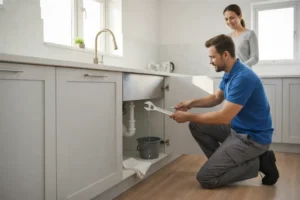
I once watched someone do the most innocent bit of DIY plumbing you can imagine: a quick tighten under the kitchen sink. No drama. No flood. Job done.
Two weeks later, the cupboard base had started to swell, the back wall felt damp, and there was that “low-key wet” smell you can’t quite place until you’d basically got your head inside the unit. It wasn’t a burst pipe. It was a tiny, steady weep that had been quietly soaking everything.
That’s the thing with plumbing. It’s not always the big, cinematic disasters. It’s the slow, hidden ones.
If you’re a homeowner in Harpenden, St Albans, Radlett, Welwyn Garden City, Borehamwood, Hemel Hempstead, Berkhamsted, or Leighton Buzzard, this is the stuff that catches people out most—especially in real-world UK houses where pipework might be older, cupboards are tight, and previous owners have left you a few “surprises”.
Why DIY plumbing feels easy (until it isn’t)
Most DIY jobs look simple because you’re only seeing the last 5% of the system: the tap, the trap, the valve, the shiny bit you can reach.
What you’re not seeing is:
- the joint that’s slightly out of line behind the fitting
- the hairline crack in a plastic trap that only leaks when the water’s hot
- the flexi hose that’s been bent a bit too sharply for years
So you tighten it, wipe it, run the tap, and it looks fine. Then life happens. The cupboard door closes. Nobody checks it again. And the leak does what leaks do.
The DIY plumbing problems that cause the most damage (quietly)
The “it’s only a drip” leak
A drip under a sink doesn’t feel urgent. Until it has been dripping for a month.
What it can lead to:
- swollen cabinet bases
- mould on the back wall
- damp that creeps into flooring
- stains on the ceiling below (if you’re unlucky)
If you’ve tightened something twice and it’s still damp, that’s not “bad luck”. It’s usually the wrong washer, a mis-seated seal, a cracked part, or a joint that needs redoing properly.
The “temporary” fix that becomes permanent
Sealant, tape, putty—they’re fine as a short stopgap. The danger is when a stopgap becomes the plan.
If you’re relying on a patch to hold back pressure, it’s basically a countdown.
The blockage that turns into a bigger job
A plunger and a decent drain snake are underrated. Chemical drain cleaners are where things get messy.
In older pipework (and plenty of homes around St Albans, Radlett, and Hemel Hempstead have it), harsh chemicals can make a weak section worse. And if the blockage doesn’t clear, you’ve now got a trap full of nasty liquid that someone has to dismantle.
If the same sink keeps blocking, or multiple drains are slow at once, it’s usually not a “one-off”.
The “why is the shower doing that?” problem
This one surprises people. You swap a tap. Fit a new shower. Install a boiling water tap. Everything works—but now the system behaves differently.
You might notice:
- banging pipes (water hammer)
- temperature swings
- pressure that drops when another tap is used
That’s not you being fussy. It’s the system telling you something’s off.
Hot water that’s suddenly not safe
If you’ve got kids (or even just guests who don’t know your house), hot water safety matters.
Thermostatic showers and TMVs aren’t glamorous upgrades, but they prevent scalding when pressure changes happen elsewhere in the house. If you’re thinking about changing temperatures or fitting new controls, it’s worth getting proper advice based on your setup.
Anything involving gas or boiler internals
This is the hard line.
If the job touches the boiler, gas pipework, flue, or anything you’re not 100% sure about, it’s Gas Safe registered engineer territory. No exceptions.
What homeowners can usually do without causing a disaster
Some DIY is genuinely fine if you’re careful and you can isolate water:
- swap a shower head/hose
- clean tap aerators and shower filters
- tighten a loose tap handle
- bleed radiators
- repressurise a combi boiler (following the manufacturer’s instructions)
The moment you’re dismantling joints, changing valves, or working on anything hidden behind tiles or under floors, the risk jumps.
The “call a pro” signs (before it gets expensive)
If any of these are true, it’s usually cheaper to get it sorted properly:
- you can’t confidently isolate the water to the area
- there’s staining, swelling, mould, or a persistent damp smell
- you’ve “fixed” it and it’s back again
- the pipework is behind a wall, under a bath, or under flooring
- you hear banging, get temperature swings, or pressure changes after an install
A quick “before you start” habit that saves people
Before you touch anything, do three things:
- Find your stopcock and make sure it turns.
- Put a bowl and towel down before you loosen anything.
- Take a photo of the setup. (You will thank yourself later.)
Local help: East & Gray (Harpenden + Hertfordshire)
East & Gray is a trusted, family-run business based in Harpenden. Since 1953, we’ve specialised in heating, plumbing, and bathroom renovations, helping homeowners across Hertfordshire including Harpenden, St Albans, Radlett, Welwyn Garden City, Borehamwood, Hemel Hempstead, Berkhamsted, and Leighton Buzzard.
Our engineers are Gas Safe registered, and we can help with:
- Boiler installation, servicing, and repairs
- Central heating installation and maintenance
- Smart heating controls and upgrades
- General plumbing services
- Boiling water tap installation
- Water softener installation
- Complete bathroom installations and wetrooms
- Bath-to-shower conversions and cloakroom refurbishments
For expert advice or to book a visit, call 01582 460185 or check our customer reviews on Google.