Home insurance feels like one of those boring adult admin jobs: you renew it, you file the documents somewhere, and you hope you never need it.
But if you’ve ever had a leak (or even just seen what one can do to a ceiling), you’ll know why insurers obsess over plumbing. Water damage is messy, it spreads fast, and it’s rarely a “quick fix” once it gets into floors, plaster, electrics, or kitchen units.
So can plumbing maintenance actually lower your home insurance? Sometimes. More often, it helps you avoid the thing that really hurts: claims and premium hikes.
This is the homeowner-friendly version of what matters, what to check, and what’s actually worth doing.
First: what insurers are really worried about
In UK policies you’ll often see wording around “escape of water”. That’s basically insurance-speak for water getting out of the pipes, tanks, or appliances and into your home.
The reason it’s such a big deal is simple:
- A tiny leak can run for days (or weeks) before anyone spots it.
- Water doesn’t stay politely in one place — it travels.
- The repair bill is usually multiple jobs: plumber, drying, plastering, sometimes an electrician, then redecoration.
Even if you never claim, insurers price your premium based on how likely a home like yours is to have that kind of loss.
Will doing maintenance get you a discount?
Usually, insurers don’t hand out discounts because you’re sensible with a torch and a screwdriver.
Where maintenance helps is more practical:
- You’re less likely to have a claim in the first place.
- If you do claim, the damage is often smaller because you caught it early.
- When you shop around, you’re not trying to explain a recent water-damage claim (which can push quotes up).
Some insurers do like certain protective measures (for example, leak detection devices or smart shut-off valves), but it varies. The bigger win is simply: don’t give water a chance to wreck your house.
The leaks that catch people out (because they don’t look dramatic)
If you picture a burst pipe spraying everywhere, that’s obvious. The more common stuff is quieter.
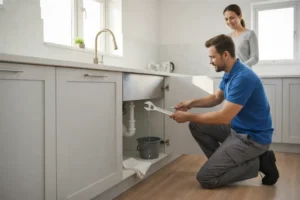
The “under the sink” leak
This is the classic. You don’t open the cupboard for a week, and by the time you do, the chipboard is swollen and everything smells damp.
What causes it?
- Old flexi hoses
- Loose fittings
- A slow drip from the waste trap
The “bath/shower” leak
Not a pipe bursting — just water creeping through failed silicone or grout.
It can show up as:
- A musty smell that never goes away
- A slightly spongy floor near the bath
- A stain on the ceiling below the bathroom
The toilet that keeps topping up
If your toilet refills itself when nobody’s used it, that’s not just annoying. It’s a sign something in the cistern isn’t sealing properly.
Sometimes it stays as a small issue. Sometimes it turns into a leak you only notice when there’s water around the base.
The maintenance that actually makes a difference
You don’t need a spreadsheet. You need a few habits that catch problems early.
1) Do a 2-minute under-sink check once a month
Pick a day you’ll remember (first weekend of the month, for example).
- Open the kitchen sink cupboard.
- Run your hand around the pipes and fittings.
- Look for dampness, crusty limescale marks, or that faint “wet wood” smell.
Do the same in the bathroom if you’ve got a basin with storage underneath.
2) Replace old flexi hoses before they split
Flexi hoses are cheap. The damage they can cause isn’t.
If a hose looks tired (cracks, bulges, rusty ends) or you honestly have no idea how old it is, it’s worth replacing proactively — especially for washing machines and dishwashers.
3) Reseal showers and baths when the seal starts failing
If silicone is peeling, cracked, or constantly going mouldy, it’s not just cosmetic.
Water will always find the easiest route. If there’s a gap, it will use it.
4) Make sure you can turn your stopcock off
This is one of those things you only care about when it’s too late.
If a pipe fails at 10pm, you want to be able to shut the water off quickly — not spend 20 minutes panicking and Googling “where is my stopcock”.
Quick test:
- Find it.
- Turn it gently to make sure it moves.
- If it’s seized or looks like it’s about to crumble, get it sorted.
5) Do a “quiet leak” water meter check
This is the closest thing to a cheat code.
- Make sure nothing is using water (no washing machine, no taps, no dishwasher).
- Look at your water meter.
- If it’s still ticking over, you may have a leak somewhere.
It’s not glamorous, but it catches the kind of leak that becomes a bigger claim later.
6) Don’t create blockages that turn into overflows
This isn’t just about convenience. A bad blockage can lead to water backing up where you really don’t want it.
The basics:
- Don’t pour fats, oils, or grease down the sink (bin it).
- Use a hair catcher in the shower.
- Don’t flush wipes, even the ones that claim they’re flushable.
7) Winter-proof exposed pipes
If you’ve got pipework in a loft, garage, or outbuilding, cold snaps can catch you out.
- Insulate exposed pipes.
- If you’re away, keep the heating on low in winter.
- Know where outdoor taps are and protect them.
Should you keep receipts or records?
You don’t need a folder labelled “PLUMBING EVIDENCE” (unless that’s your thing).
But it is worth keeping:
- A couple of photos if you’ve had a repair done
- Receipts or invoices for plumbing work
- A quick note in your phone of the date
If you ever need to claim, being able to show you dealt with issues promptly can make the whole process less painful.
A simple plan you can actually follow
If you want the short version:
- Check under sinks for damp once a month
- Make sure the stopcock turns
- Replace tired hoses
- Reseal baths or showers when silicone fails
- Do a water meter “quiet leak” check
If you’re in Hemel Hempstead, Berkhamsted, or Leighton Buzzard and you’d rather have someone sanity-check things (especially if you’ve had repeat leaks, damp patches, or slow drains), East & Gray can help you prioritise the fixes that prevent bigger damage.